[백준/C++] 14572번: 스터디 그룹
[백준/C++] 14572번: 스터디 그룹
문제 & 링크
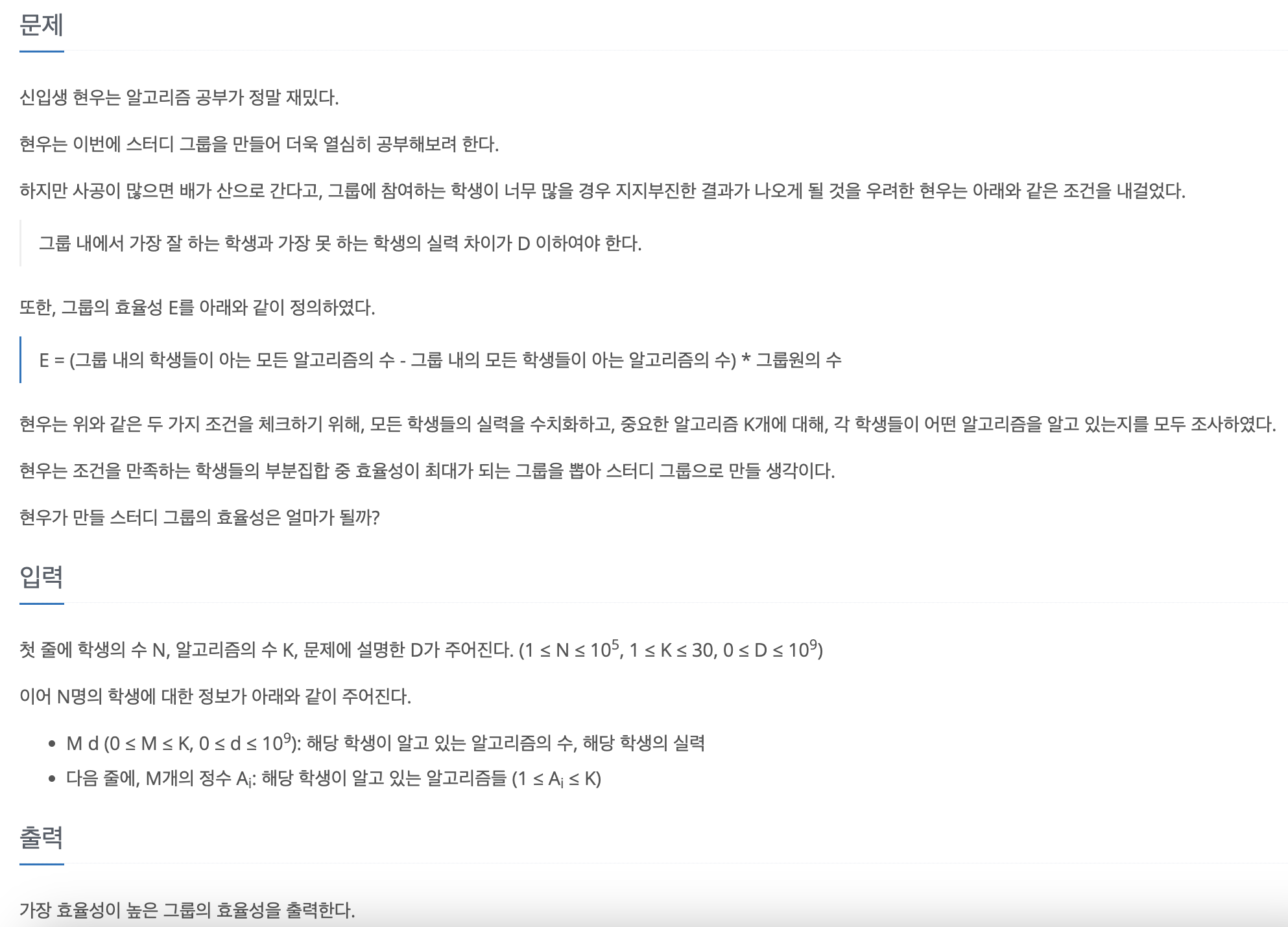
https://www.acmicpc.net/problem/14572
풀이
각 학생의 정보를 저장하는 벡터를 선언한다. 이때 정렬할 것을 고려하여 학생의 실력을 pair의 first로 두고, 해당 학생이 알고있는 알고리즘들을 벡터로 하여 pair의 second로 둔다.
학생의 정보를 저장해놓은 벡터를 정렬한다.
실력의 차이가 D 이하인 조건을 기준으로 하여 투 포인터 기법을 사용한다. 실력의 차이가 D 이하라면 두 번째 포인터를 한 칸 앞으로 옮기고, 실력의 차이가 D 초과라면 첫 번째 포인터를 한 칸 앞으로 옮긴다.
그룹의 효율성을 구하는 함수를 위해 각 알고리즘을 몇 명이 아는지 저장하는 해쉬맵을 선언한다.
4-1. 그룹 내의 학생들이 아는 모든 알고리즘의 수는 해쉬맵의 value가 1 이상인 key의 개수이다.
4-2. 그룹 내의 모든 학생들이 아는 알고리즘의 수는 해쉬맵의 value가 그룹 인원 수 이상인 key의 개수이다.
- 벡터의 모든 원소를 투 포인터가 순회하도록 종료 조건을 설정하여 최대 효율성을 구한다.
코드
1
2
3
4
5
6
7
8
9
10
11
12
13
14
15
16
17
18
19
20
21
22
23
24
25
26
27
28
29
30
31
32
33
34
35
36
37
38
39
40
41
42
43
44
45
46
47
48
49
50
51
52
53
54
55
56
57
58
59
60
61
62
63
64
65
66
67
68
69
70
71
72
73
74
75
76
77
78
79
#include <iostream>
#include <vector>
#include <unordered_map>
#include <algorithm>

using namespace std;

vector<pair<int, vector<int>>> V;

unordered_map<int, int> hash_map;

int main() {
    ios_base::sync_with_stdio(false);
    cin.tie(NULL);

    int N, K, D;
    cin >> N >> K >> D;


    for (int i = 0; i < N; i++) {
        int M, d;
        cin >> M >> d;
        vector<int> tmp(M);
        for (int j = 0; j < M; j++) {
            cin >> tmp[j];
        }
        V.push_back(make_pair(d, tmp));
    }

    sort(V.begin(), V.end());

    int point1 = 0;
    int point2 = 0;
    for (int i = 0; i < V[point2].second.size(); i++) {
        hash_map[V[point2].second[i]]++;
    }
    int ans = 0;
    int student_cnt = 1;
    while (1) {
        if (point1 == N || point2 == N) break;

        if (V[point2].first - V[point1].first <= D) {
            int all_known_algo_cnt = 0;
            int all_student_known_algo_cnt = 0;

            for (auto& i : hash_map) {
                if (i.second >= student_cnt) all_student_known_algo_cnt++;
                if (i.second >= 1) all_known_algo_cnt++;
            }

            int E = (all_known_algo_cnt - all_student_known_algo_cnt) * student_cnt;
            ans = max(ans, E);

            if (point2 < N - 1) {
                student_cnt++;
                point2++;
                for (int i = 0; i < V[point2].second.size(); i++) {
                    hash_map[V[point2].second[i]]++;
                }
            }
            else {
                for (int i = 0; i < V[point1].second.size(); i++) {
                    hash_map[V[point1].second[i]]--;
                }
                student_cnt--;
                point1++;
            }

        }
        else {
            for (int i = 0; i < V[point1].second.size(); i++) {
                hash_map[V[point1].second[i]]--;
            }
            student_cnt--;
            point1++;
        }
    }
    cout << ans;
}
This post is licensed under CC BY 4.0 by the author.